Back pain is common today due to prolonged sitting, poor posture, sedentary lifestyle, repetitive physical work, lack of exercise, and age-related changes in the spine.
One important cause of persistent back pain is disc prolapse, commonly called a slipped or herniated disc. When a spinal disc irritates or compresses a nearby nerve, pain may extend from the back into the buttock or leg, sometimes with tingling, numbness, or weakness.
What Is Disc Prolapse?
Intervertebral discs are soft structures between the vertebrae that act as cushions and absorb movement and load.
Due to ageing, injury, repeated strain, or degenerative changes, a disc may bulge or develop a tear, allowing its inner material to move outward. Depending on the extent of the problem, it may be described as:
- Disc bulge
- Disc protrusion
- Disc extrusion
- Disc herniation or prolapse
- Sequestered disc
Symptoms become more significant when the disc irritates or compresses a spinal nerve.
Symptoms of Disc-Related Back Pain
Common symptoms include:
- Lower back pain
- Pain extending into the buttock or leg
- Sciatica
- Tingling or pins-and-needles
- Numbness in the leg or foot
- Difficulty sitting or bending
- Muscle weakness in significant nerve compression
Leg pain occurs when an affected spinal nerve becomes irritated. This is commonly experienced as sciatica, with pain travelling from the lower back through the buttock, thigh, calf, or foot.
How Ayurveda Understands Back Pain
Ayurveda describes back and radiating leg pain under conditions such as Katishoola, Prishta Shoola, and Gridhrasi, depending on the clinical presentation.
Vata plays an important role in pain and movement. Factors such as excessive physical activity, prolonged sitting, irregular food habits, inadequate rest, ageing, constipation, and physical strain may contribute to Vata aggravation.
Ayurvedic assessment also considers digestion, bowel habits, sleep, activity, constitution, pain pattern, and overall health.
Ayurvedic Approach to Disc-Related Back Pain
Treatment is individualized according to the patient’s condition and may include external therapies, internal medicines, Marma therapy, Panchakarma, diet, lifestyle modification, and rehabilitation advice.
- External Therapies
Depending on the condition, therapies such as Abhyanga, Kati Basti, Pizhichil, Patra Pinda Sweda, and Shashtika Shali Pinda Sweda may be considered.
The treatment is selected according to pain, stiffness, muscle involvement, and the patient’s overall condition.
- Marma-Based Therapy
Marma Chikitsa may be incorporated in selected cases as part of an individualized approach to musculoskeletal pain and restricted movement.
- Internal Medicines
Medicines are selected according to symptoms, Dosha involvement, digestive status, strength, age, and associated conditions.
Depending on the presentation, classical formulations such as:
- Rasna Saptakam Kashayam
- Varunadi Kashayam
- Rasneerandadi Kashayam
- Mahamanjishtaadi Kashayam
- Maharasnadi Kashayam
- Yogaraja Guggulu
- Kaishora Guggulu
may be considered.
These are not a fixed combination for every patient. The medicines and duration should be decided by a qualified Ayurvedic physician after assessment.
- Panchakarma
Panchakarma may be considered in selected chronic or recurrent cases. Depending on the patient, procedures may include Snehapana, Virechana, Sneha Basti, and Kashaya Basti (Niruha Basti).
Basti is traditionally considered important in Vata-related conditions, with the type, medicines, and duration selected according to the individual patient.
Can Ayurveda Help With Disc Prolapse?
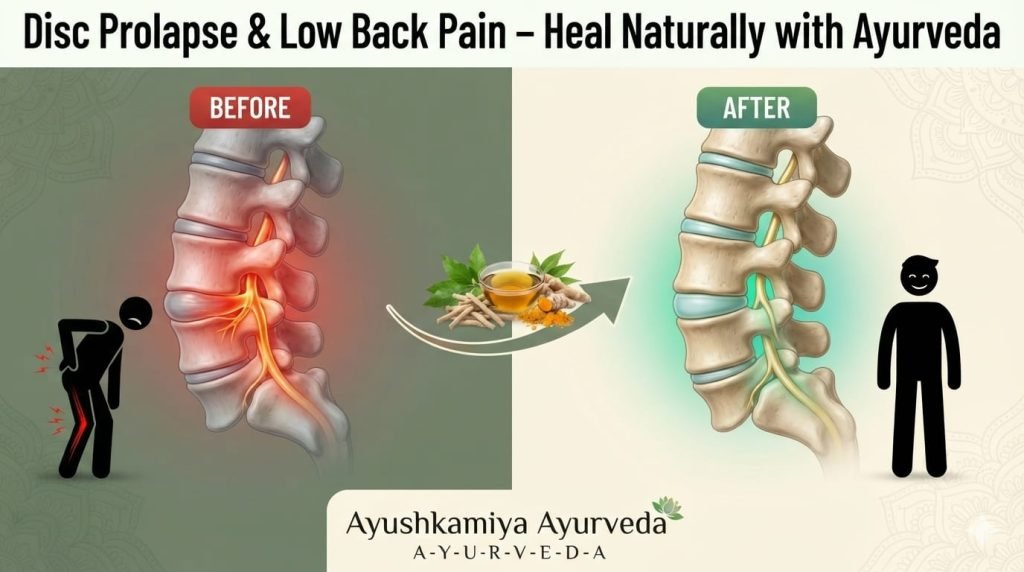
Yes, Ayurveda can help in the management of disc prolapse, and in some cases, Ayurvedic treatment may help reduce the disc prolapse itself.
However, this is generally a gradual process and should not be expected within a few days or weeks. Depending on the severity of the disc prolapse, nerve involvement, duration of the condition, and the patient’s overall health, it may take around six months to one year or sometimes longer to achieve significant improvement and possible reduction in the disc bulge or herniated portion.
Ayurvedic treatment may also help reduce pain and stiffness, improve mobility, support nerve and musculoskeletal function, and improve overall quality of life.
The treatment plan is individualized according to the patient’s condition and may include Ayurvedic medicines, external therapies, Marma therapy, Panchakarma, dietary modifications, lifestyle changes, and appropriate rehabilitation.
The expected results and treatment duration vary from person to person. Therefore, proper clinical assessment, along with relevant investigations such as an MRI when available, is important before deciding the treatment plan.
When Should You Seek Medical Attention?
Disc-related symptoms accompanied by progressive leg weakness, significant loss of sensation, saddle-area numbness, or new bladder or bowel problems require prompt medical evaluation.
Lifestyle for a Healthy Back
Along with treatment:
- Avoid prolonged sitting without movement breaks.
- Maintain a comfortable sitting posture.
- Avoid sudden heavy lifting.
- Use proper lifting techniques.
- Maintain a healthy body weight.
- Gradually strengthen the core and back with suitable guidance.
- Get adequate sleep and recovery.
- Avoid returning to strenuous activity too quickly after an acute episode.
Exercise should be individualized according to the condition.
Our Ayurvedic Approach to Back Pain
At Ayushkamiya Ayurveda, we look beyond the location of pain. Our assessment considers symptoms, duration of the condition, lifestyle, digestion, bowel habits, physical activity, previous treatments, and available investigations such as MRI reports.
Based on the assessment, treatment may include traditional Ayurvedic therapies, internal medicines, Marma-based therapy, Panchakarma, dietary guidance, lifestyle modification, and rehabilitation-oriented advice.
Our approach is rooted in traditional Kerala Ayurveda, with an emphasis on individualized treatment and clinical assessment.
Why Choose Ayushkamiya Ayurveda?
Ayushkamiya Ayurveda carries forward a tradition of Ayurvedic practice developed through generations.
We provide Ayurvedic care for:
- Chronic back pain
- Disc-related back pain
- Disc prolapse
- Sciatica
- Knee pain
- Sports and ligament-related injuries
- Musculoskeletal conditions
- Other chronic pain conditions
Our treatments are based on classical Ayurvedic principles, with an emphasis on personalized assessment and traditional therapeutic practices.
Patients with MRI or other investigation reports can have them reviewed along with their clinical history to understand their condition more comprehensively.
Conclusion
Disc prolapse can cause persistent back pain and, when nerves are involved, symptoms extending into the leg.
Ayurveda takes an individualized approach, considering pain characteristics, Vata, digestion, lifestyle, tissue health, and the patient’s overall condition.
Yes, Ayurveda can help manage disc prolapse, and in some cases, reduction in the disc prolapse may also occur with treatment. However, this is usually gradual and may take six months to one year or longer depending on the individual condition.
Ayushkamiya Ayurveda provides personalized Ayurvedic care for back pain, disc prolapse, and sciatica based on traditional Ayurvedic principles and individual clinical assessment.